Healthy eating, the right steps in the right order


Healthy eating starts with 1 week of observation, without changing anything. This starting snapshot shows the 2 or 3 habits that really matter. Then change a single habit at a time, and keep it for 2 weeks before moving on to the next. No list of banned foods, no set menu.
A club coach looks at your situation with you and gives you the best advice.
Book your free assessmentIn this article
Healthy eating or dieting
A diet imposes strict rules for a short time, then stops. The weight then comes back, which is how yo-yo dieting works. Healthy eating adjusts the way you eat every day, with your own dishes and your family meals. A way of eating that does not last 6 months is just a diet in disguise.
The observation week
For 7 days, write down what you eat and when, without correcting or judging yourself. A notebook or a note on your phone is enough.
- Write everything down. The sugar in your tea, the handful of biscuits by the cupboard, the Friday glass of wine.
- Spot your weak moments. Mid-afternoon, getting home from work, the quiet after 9pm. Knowing the time works better than fighting the craving.
- Choose a single thing to change. The easiest, not the most spectacular.
The balanced plate, the Eatwell way
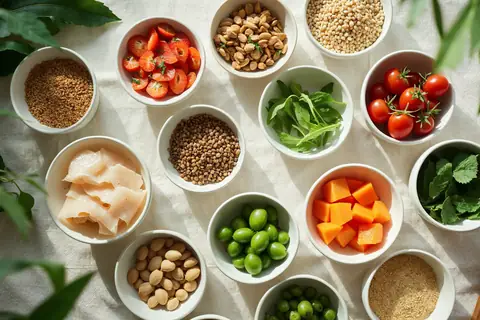
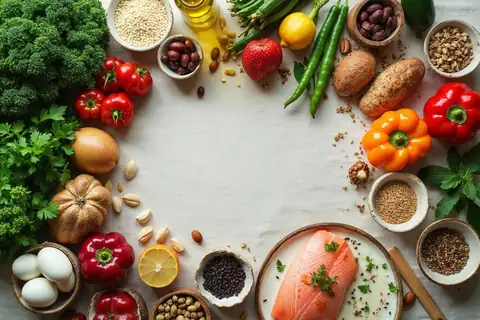
The UK model is the Eatwell Guide, published by the government. As the NHS page on the Eatwell Guide explains, fruit and vegetables should make up just over a third of what you eat each day, with at least 5 portions. Starchy foods such as potatoes, bread, rice and pasta make up just over a third too, ideally higher fibre or wholegrain. The rest is protein foods, such as beans, pulses, fish, eggs and meat, plus some dairy or alternatives.
Starchy foods fully belong on a healthy plate, as our page on starchy foods for weight loss shows. Protein contributes to the maintenance of muscle mass, and our guide gives the amounts for protein every day.
Frequency rather than bans
A banned food becomes a craved food. After 3 weeks of going without, many people give in and then give up. The Sunday pudding stays. The daily fizzy drink becomes occasional. Nothing disappears, everything shifts.
The NHS 8 tips for healthy eating follow the same spirit. Do not skip breakfast, eat more fish, cut down on saturated fat and sugar, and eat less salt, no more than 6g a day for adults. Pick 1 tip, not all 8.
How long results take
More energy and fewer cravings are often felt within a few days. On the scales, allow 2 to 4 weeks to see the number move, and 1 to 3 months for your shape to change. The NHS suggests 0.5 to 1kg a week, which is 1 to 2lb. Weigh yourself once a week, on the same day, because weight varies by 1 to 2kg with hydration and digestion. This article does not replace advice from your GP or another health professional.
At Witney Nutrition Club
At Witney Nutrition Club, coaches trained in nutrition support members every day. The free assessment helps you set a realistic goal and choose the 1st change to make.
Meal by meal





Your weight loss curve
Enter your profile and the curve redraws straight away.
At the median pace, it would take about 11 weeks to lose 8 kg. At the gentlest pace, about 4 months.
The benchmark most often given for lasting weight loss is 500 g to 1 kg a week. That is the ideal zone of the chart. Above 1 kg a week on a regular basis, the body draws on its muscles as much as on its fat. That is the hatched zone.
An indicative projection. Every journey is personal and results vary from person to person. The calculation runs on your device, nothing is saved or sent. Over 65, talk to your doctor first.
How this curve is calculated
The top edge of the zone matches 500 g a week, the gentlest pace. The bottom edge matches 1 kg a week, the risk threshold.
The first weeks go faster, mostly water, then the pace slows. After 40, the median curve slows gradually, because metabolism slows. For the same effort, a man usually loses weight a little faster than a woman.
The journey curve adds plateaus of a few days and small regains, as in real life. It does not predict your own journey.
This advice is general. It does not replace medical advice.
Further reading

For day to day support, see the healthy eating programme.