Good fats and weight loss, quality and quantity

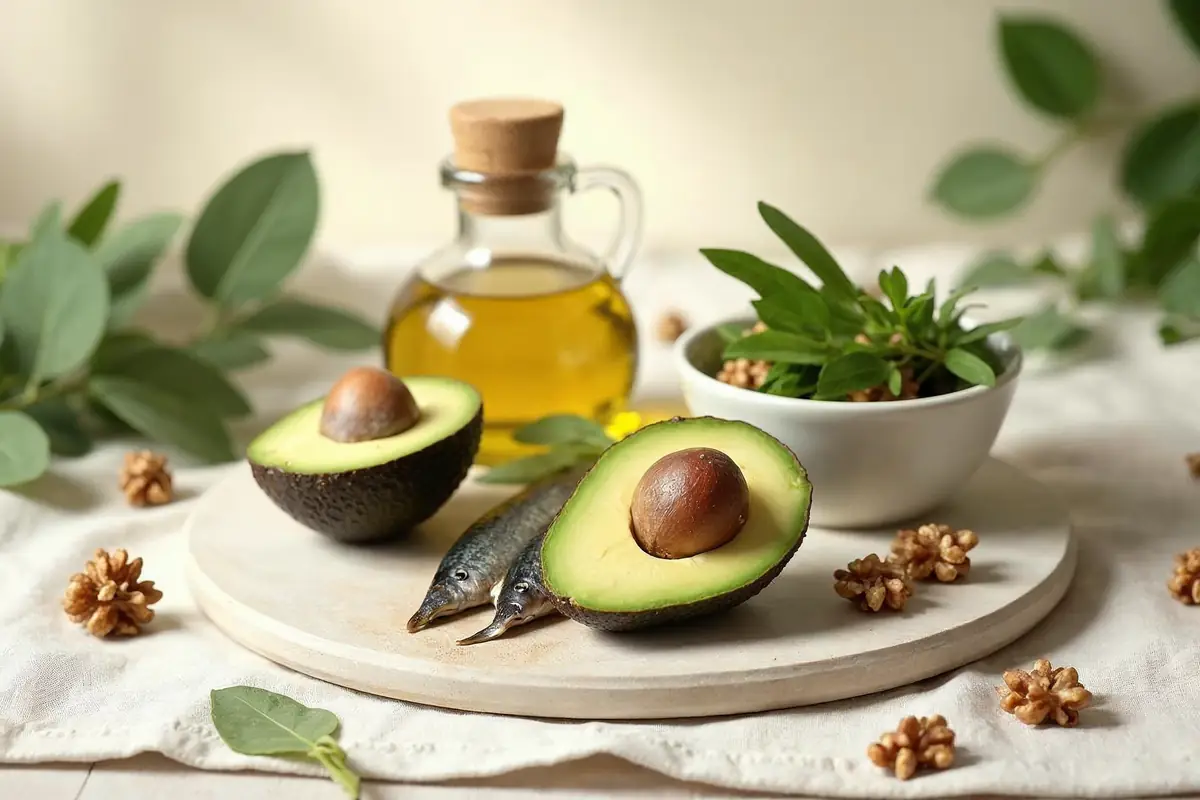
Yes, good fats have their place in weight loss. As the British Dietetic Association explains, fat provides energy and essential fatty acids and helps the body absorb vitamins A, D, E and K. What matters is the type of fat and the amount.
A club coach looks at your situation with you and gives you the best advice.
Book your free assessmentIn this article
What fat does in the body
Some fatty acids are called essential. The body cannot make them, so they have to come from food. They belong to the omega-3 and omega-6 families. Oily fish also provides DHA, a long-chain omega-3. DHA contributes to the maintenance of normal brain function. Fats are 1 of the nutrients described on our page about nutrients, their roles and needs.
How much fat a day
The BDA advises that about a third of our daily energy should come from fat, mostly unsaturated. The NHS page on fat in your diet adds a limit on saturated fat.
- Men, no more than 30g of saturated fat a day.
- Women, no more than 20g of saturated fat a day.
UK guidelines advise cutting down on fat overall and replacing saturated fat with some unsaturated fat. Replacing saturated fats with unsaturated fats in the diet contributes to the maintenance of normal blood cholesterol levels.
Good fats while losing weight
1g of fat provides 9kcal, more than twice as much as protein or carbohydrate at 4kcal. That is why hidden fat adds up quickly over a day. Pastries, sausage rolls, crisps, fried food and ready meals are full of it.
Cutting out all fat would still be a mistake. Fat-free meals are often less satisfying, and many people end up snacking later, a trap described on our page about how to curb hunger naturally. The right move is to keep good oils and reduce hidden fats. Fad diets that ban all fat rarely last.
Where to find good fats
- Rapeseed oil, walnuts and linseed, for plant omega-3, according to the BDA omega-3 fact sheet.
- Oily fish, such as mackerel, sardines, herring, kippers, trout or salmon, for EPA and DHA.
- Olive oil, avocado and almonds, for monounsaturated fats.
The NHS advises that a healthy diet includes at least 2 portions of fish a week, including 1 of oily fish. An adult portion is about 140g. Fresh and tinned tuna do not count as oily fish. During pregnancy, some fish are limited, so ask your midwife or GP.
Too little or too much
Too little fat usually shows as meals that do not satisfy and a diet short of omega-3. Too much, especially saturated fat, pushes up the energy of the day and can raise cholesterol. If your cholesterol is high, your GP will tell you what to do. This article does not replace advice from your GP or another health professional.
At Witney Nutrition Club
At Witney Nutrition Club, the coaches are trained in nutrition and support members every day. During the free assessment, your coach can look at the fats in your usual meals with you and suggest simple swaps.
Your weight loss curve
Enter your profile and the curve redraws straight away.
At the median pace, it would take about 11 weeks to lose 8 kg. At the gentlest pace, about 4 months.
The benchmark most often given for lasting weight loss is 500 g to 1 kg a week. That is the ideal zone of the chart. Above 1 kg a week on a regular basis, the body draws on its muscles as much as on its fat. That is the hatched zone.
An indicative projection. Every journey is personal and results vary from person to person. The calculation runs on your device, nothing is saved or sent. Over 65, talk to your doctor first.
How this curve is calculated
The top edge of the zone matches 500 g a week, the gentlest pace. The bottom edge matches 1 kg a week, the risk threshold.
The first weeks go faster, mostly water, then the pace slows. After 40, the median curve slows gradually, because metabolism slows. For the same effort, a man usually loses weight a little faster than a woman.
The journey curve adds plateaus of a few days and small regains, as in real life. It does not predict your own journey.
This advice is general. It does not replace medical advice.
Further reading

For day to day support, see the healthy eating programme.